Service Dog Tasks and the Public Access Test, Explained
This page explains the law in general terms. It is not legal advice. For a specific situation, contact the agency listed on this site or an attorney.
Two ideas come up again and again when people prepare a service dog in New Mexico: the tasks the dog does, and the public access test. They are related, but they are not the same thing, and only one of them is part of the legal definition of a service dog.
This guide walks through both in order. You will learn how to identify and train a task, how to build the public manners that an access test measures, and where the law in New Mexico and under the ADA actually draws its lines.
The short version
- Under the ADA, a service animal is a dog individually trained to do work or perform tasks for an individual with a disability, according to the ADA.gov Service Animals FAQ.
- The work or task must connect to the person's disability. Comfort alone is not a task.
- The public access test is a training benchmark used by many programs, including those that follow Assistance Dogs International (ADI) standards. It is not a legal requirement under the ADA.
- There is no official service dog registry or required certification under the ADA.
What you need before you start
You do not need to buy special gear to begin. Gather these things first:
- A written list of the specific ways your disability affects your day. This is the starting point for choosing tasks.
- A dog with a steady, friendly temperament and good health. Your own doctor and a veterinarian can help you judge whether a particular dog is a good fit.
- Small, soft, high-value treats and a flat buckle collar or a well-fitted harness.
- A six-foot leash and a mat or blanket for settle practice.
- A notebook or phone to log each training session.
- A trainer or program that uses humane, reward-based methods, if you want coaching.
Training in line with the American Veterinary Society of Animal Behavior (AVSAB) means rewarding the behavior you want. Shock, prong and choke collars, alpha rolls, scruffing and dominance methods are not part of this work.
Step 1: Understand what counts as a task
The ADA.gov Service Animals FAQ describes a service animal as a dog individually trained to do work or perform tasks for a person with a disability. The key word is trained. The dog has to learn a deliberate behavior that helps with a disability-related need.
New Mexico's Service Animal Act, Chapter 28, Article 11 NMSA 1978, uses similar wording. Section 28-11-2 defines a qualified service dog as a dog trained or being trained to work or perform tasks for the benefit of a person with a disability. The state definition also covers psychiatric and mental impairments through its "physical or mental impairment" wording. It applies to dogs and miniature horses only.
Why comfort alone is not a task
A dog that makes its owner feel calmer just by being nearby is offering comfort. That can matter a great deal to a person, but it is not trained work. The New Mexico Service Animal Act excludes pets and emotional support, comfort or therapy animals from its definition. Under the ADA, emotional support, therapy and comfort animals are not service animals.
A psychiatric service dog is different. It is trained to perform a specific action that responds to a symptom, not just to be present. The test is whether the dog does something on cue or in response to a trained signal.
Step 2: Match tasks to your disability
People often ask what tasks a service dog can do. The honest answer is that the list is open, because tasks are shaped around the individual handler. The examples below show the kind of trained behaviors that programs commonly teach. They are illustrations, not a legal list.
| Type of disability | Examples of trained tasks |
|---|---|
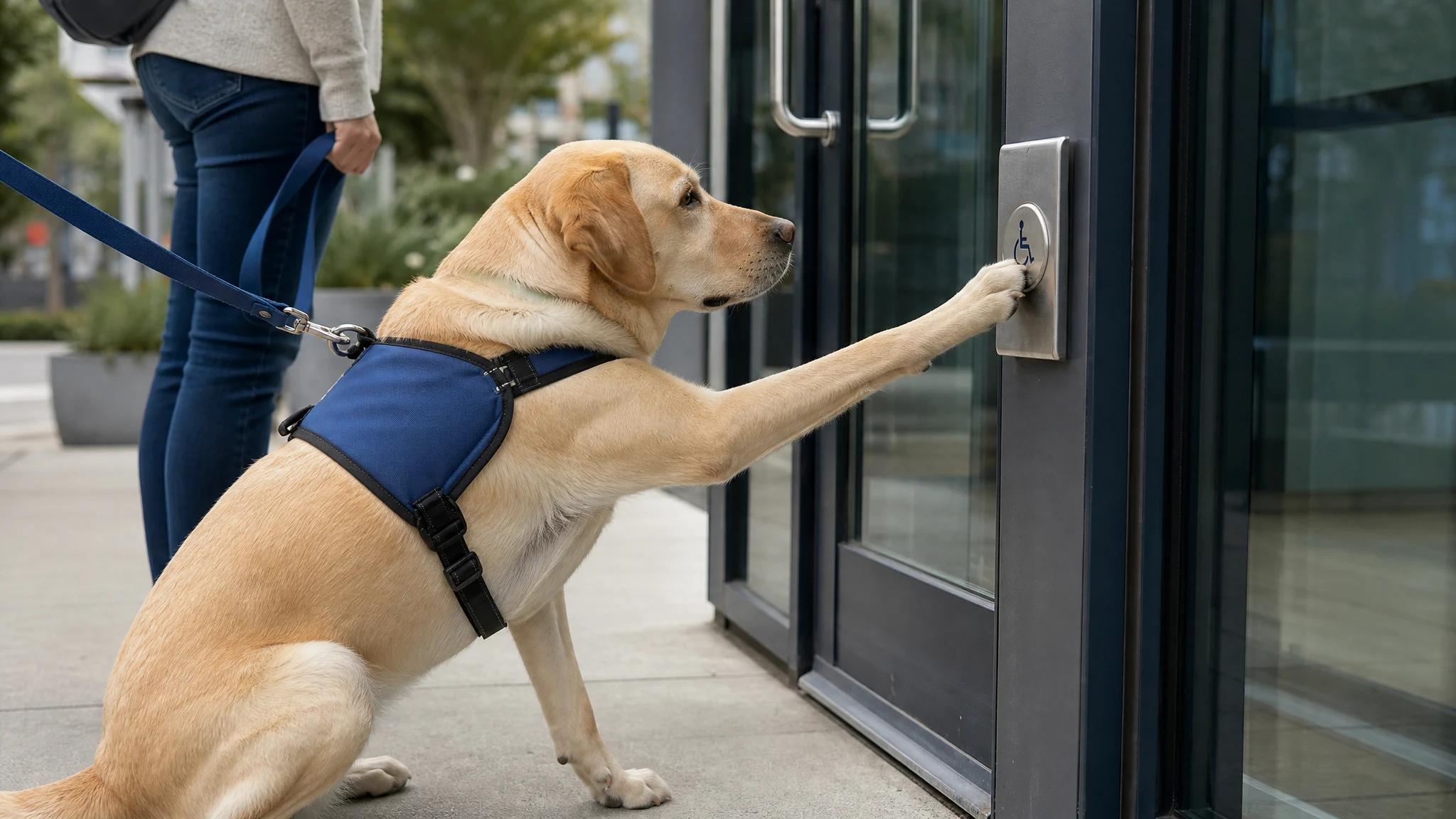
| Mobility | Retrieving dropped items, opening and closing doors, turning lights on, bracing for balance when standing, pulling a manual wheelchair |
| Seizure | Responding to a seizure by staying with the person, fetching a phone, getting help, or alerting if the dog has been trained to do so |
| Diabetes | Alerting the handler to a change the dog has been trained to notice, then fetching supplies |
| Psychiatric or PTSD | Interrupting repetitive or harmful behaviors, creating space in a crowd, turning on lights and checking a room, applying deep pressure on cue |
| Hearing | Alerting to a doorbell, alarm or a person calling the handler's name |
| Vision | Guiding around obstacles, stopping at curbs and stairs |
| Developmental disabilities | Interrupting self-harm, keeping a child from bolting, guiding the person back to a caregiver |
New Mexico programs describe serving several of these groups. Assistance Dogs of the West in Santa Fe, an ADI accredited program, lists mobility, seizure, diabetic alert, psychiatric, PTSD and developmental disability work on its site. Check with the program directly for what it currently offers.
Step 3: Choose and define one task at a time
Pick a single task that would make a real difference in your daily life. Write it as a clear sentence: "When I give the cue 'light,' the dog switches on the lamp with a paw." A task described this way is easier to teach and easier to explain if you are ever asked about it.
Break the task into small pieces. For a door-opening task, the pieces might be touching a tug strap with the nose, then pulling, then pulling until the door opens, then closing it. Reward each small success before you ask for more.
Step 4: Teach the task with rewards
- Mark and reward. Use a clicker or a short word such as "yes" the instant the dog does the right thing, then deliver a treat.
- Shape in short sessions. Keep sessions to a few minutes. End while the dog is still keen.
- Add the cue. Once the dog offers the behavior reliably, say the cue just before it happens.
- Add distance, duration and distraction one at a time. If the dog struggles, make the next step easier.
- Practice in different rooms and places. Dogs do not automatically carry a skill from the kitchen to a store.
- Keep a log. Note the date, the task and how it went. Records help you see progress and show that the training is deliberate.
Step 5: Understand the public access test
The public access test is a way of checking whether a dog behaves well enough in public to work safely. Many programs use a version of it, and ADI standards are commonly used as the reference point for it. Think of it as a training benchmark, not a government exam.
It is not a legal requirement under the ADA. The ADA.gov Service Animals FAQ does not tell handlers to pass a test, and there is no official service dog registry or required certification under the ADA. A certificate or ID card from an online seller is not legal proof of anything. Do not buy one, and be wary of any site that says otherwise.
If you want to use the ADI version, ask ADI or an accredited program for the current test items and scoring. This guide does not reproduce them, because the exact wording and requirements are set by the organization.
What public access skills usually cover
Without quoting any one test, public access skills generally fall into a few groups:
- Calm behavior around people, food, noise and other animals.
- Walking politely on a loose leash.
- Settling under a table or beside a chair and staying there.
- Staying focused on the handler instead of strangers or smells.
- Staying clean and well groomed, and relieving itself only on cue or in suitable places.
- Handling doors, elevators and tight spaces without trouble.
Step 6: Build public access skills gradually
- Start quiet. Practice in your yard, then a quiet hallway, then a parking lot.
- Move to low-stress places. Dog-friendly outdoor spaces work well. Ask permission before going into private businesses while the dog is still learning.
- Reward calm. Treat the dog for lying down quietly and for ignoring distractions.
- Increase difficulty slowly. Add busier stores, crowds and longer outings only when the dog is relaxed at the current level.
- Watch for stress. Yawning, lip licking, panting or refusing food are signs to back off and make things easier.
- Retest yourself. Run through the skills regularly, with a friend watching if you can. Write down what to improve.
How the law applies in New Mexico
Under Section 28-11-3 of the New Mexico Service Animal Act, a person with a disability using a qualified service animal must be admitted to any building open to the public, other public accommodations and common carriers, even where there is a no-pets policy. The animal must be under the control of an owner, trainer or handler. No additional charge may be imposed for the animal, though the handler may be liable for damage the animal causes if a person without a disability would be liable for similar damage.
Access may be denied where the animal poses a direct threat of significant harm to the health or safety of others. A dog that is out of control is a practical reason to build solid public manners.
The state's definition covers dogs that have been or are being trained. The New Mexico Governor's Commission on Disability says animals in training get the same access. The pages it publishes do not state age, harness or ID conditions.
What staff may ask
According to the ADA.gov Service Animals FAQ, when the need is not obvious, staff may ask only two questions:
- Is the dog a service animal required because of a disability?
- What work or task has the dog been trained to perform?
This is where a clearly defined task helps. A short, calm answer such as "She alerts me to a change in my condition and brings my supplies" covers the second question. Practice your answer ahead of time.
Misrepresentation
Section 28-11-6 makes it a misdemeanor to knowingly present as a qualified service animal any animal that does not meet the Section 28-11-2 definition. It is punished under Section 31-19-1 NMSA 1978. The Governor's Commission on Disability describes the penalty as a $1,000 fine and/or jail time.
For more on rights, training access and where service dogs may go, see our guide to service dogs in New Mexico: training, access rights and where.
Tips and common mistakes to avoid
- Calling comfort a task. If the dog only provides presence, it is not performing trained work under the ADA.
- Treating the public access test as a legal gate. It is a benchmark. You are not required to pass a test or carry papers under the ADA.
- Buying a registry, ID or certificate. These have no official standing under the ADA.
- Rushing into busy places. Overloading the dog can create fear or reactivity that takes months to repair.
- Using harsh tools. Corrections can damage trust and make a dog less reliable under stress. Stay with reward-based training.
- Skipping records. Notes on training sessions help you track progress and describe the work honestly.
- Training too many tasks at once. Build one reliable task before starting the next.
- Ignoring the dog's wellbeing. Plan for rest, play and off-duty time.
Expected results
With regular, patient, reward-based practice, many handlers find that a dog can learn a basic task over several weeks to months. Public access skills often take longer, because they depend on the dog maturing and gaining experience in many settings. Timelines vary a lot between dogs, and not every dog is suited to service work.
You may notice that the dog settles more easily in public and responds to cues more reliably. It is not possible to promise a particular result. Some dogs may need more time, a different task or a different career. If a dog is stressed or unsuited to the work, choosing a different path is a responsible outcome.
Where to get help in New Mexico
If you would rather train with support, a few New Mexico organizations are listed here. Fees, waitlists and eligibility change, so contact each one directly.
- Assistance Dogs of the West in Santa Fe is ADI accredited. Its cost for receiving a dog is not published. For its Owner Self-Training program, it says additional costs may apply based on the number of training hours needed.
- Service Dogs of New Mexico in Albuquerque is a nonprofit that says it specializes in assisting veterans, adults and children. Its site says it is accepting 2026/2027 new client applications. Fees are not stated, so ask the organization.
- Paws and Stripes in Albuquerque serves veterans, including those with PTSD and service-connected trauma. Its Veteran Service Dog Program is a 12-month program for veterans 18 and older, with photo ID required. The organization publishes it as free. Contact is (505) 999-1201.
- Warrior Canine Connection through Assistance Dogs of the West lets veterans learn to train service dogs for other people. It meets weekly in Albuquerque, Santa Fe and Taos. It is listed as free, for ages 18 to 100. Phone is (505) 986-9748.
For a complaint about access, the contact details for the state agency are not confirmed here. Check with the New Mexico Governor's Commission on Disability and the ADA.gov Service Animals FAQ for the current process. This article states the law in plain terms and is not legal advice.
Sources
- ADA.gov Service Animals FAQ
- New Mexico Statutes, Section 28-11-2 (definitions)
- New Mexico Statutes, Section 28-11-3 (admittance of qualified service animal)
- New Mexico Statutes, Section 28-11-6 (false presentation)
- New Mexico Governor's Commission on Disability, Service Animals
- Assistance Dogs of the West
- Service Dogs of New Mexico
- Paws and Stripes
- Paws and Stripes Veteran Service Dog Program
- Warrior Canine Connection (Assistance Dogs of the West)