Service Dogs in New Mexico: Training, Access Rights and Where to Start
This page explains the law in general terms. It is not legal advice. For a specific situation, contact the agency listed on this site or an attorney.
A service dog can change how a person with a disability moves through daily life. Getting one in New Mexico means understanding two layers of law, choosing between a program-trained dog and an owner-trained dog, and knowing which local organizations exist.
This guide covers who qualifies, what the ADA and New Mexico law say about public access, what training involves, what we can and cannot say about cost, and how to take a first step. It describes the law in plain English. It is not legal advice.
Table of Contents
- What counts as a service dog in New Mexico
- Who qualifies for a service dog
- Access rights under the ADA and New Mexico law
- The two routes: program-trained or owner-trained
- What service dog training involves
- Costs, waitlists and what is not published
- New Mexico organizations and veteran programs
- Where to start: a practical first-steps list
Key Takeaways
- Under the ADA, a service animal is a dog individually trained to do work or perform tasks for a person with a disability (ADA.gov Service Animals FAQ).
- New Mexico's Service Animal Act covers qualified service dogs and qualified service miniature horses, including those being trained.
- Emotional support, comfort and therapy animals are not service animals under the ADA, and New Mexico's definition also excludes them.
- There is no official registry or required certification under the ADA. Online registration is not legal proof of anything.
- You can get a dog through a program or train your own. Costs and waitlists for most New Mexico programs are not published, so ask each organization directly.
- Knowingly presenting a pet as a qualified service animal is a misdemeanor under New Mexico law.
What Counts as a Service Dog in New Mexico
Two definitions matter here: the federal one and the state one. They overlap, but they are not identical.
The federal definition
The ADA.gov Service Animals FAQ says a service animal is a dog individually trained to do work or perform tasks for an individual with a disability. The key words are "individually trained" and "work or tasks." The dog does something specific that helps with the person's disability.
Examples of tasks include guiding a person who is blind, alerting to a seizure, retrieving items for someone with limited mobility, or interrupting a harmful behavior. The task must connect to the disability. Simply being present and providing comfort does not meet the federal definition.
The New Mexico definition
New Mexico's Service Animal Act is found in Chapter 28, Article 11 of the New Mexico Statutes Annotated 1978 (Sections 28-11-1 to 28-11-6). Section 28-11-2 defines a qualified service animal as a qualified service dog or a qualified service miniature horse that has been or is being trained to assist a person with a disability.
It defines a qualified service dog as a dog trained or being trained to work or perform tasks for the benefit of a person with a disability. The statute excludes pets and emotional support, comfort or therapy animals. It covers psychiatric and mental impairments through its "physical or mental impairment" wording. It applies to dogs and miniature horses only.
Two points stand out. First, the state definition includes dogs that are still in training. Second, it names miniature horses, which the federal definition's core language does not. If you are relying on a miniature horse, read the statute and check with the agencies listed in the Sources section.
What does not count
The distinction is exact, and it matters for your rights:
- Emotional support animals are not service animals under the ADA.
- Therapy animals, which visit hospitals or schools, are not service animals under the ADA.
- Comfort animals and pets are not service animals under the ADA.
Emotional support animals can still matter in housing. The New Mexico Governor's Commission on Disability states that emotional support animals are covered under the federal Fair Housing Act. That is a housing rule, not a public access rule. We come back to it below.
Who Qualifies for a Service Dog
The ADA does not publish a list of qualifying conditions. It is built around the person's disability and the dog's training. A person with a physical, sensory, psychiatric, intellectual or other mental disability may use a service dog if the dog is trained to do work or tasks related to that disability.
The New Mexico statute speaks of a "physical or mental impairment," which brings psychiatric conditions within its reach. The programs listed later in this guide describe the groups they serve, which include mobility needs, seizure disorders, diabetic alert, psychiatric conditions, PTSD and developmental disabilities.
No doctor's note is required for public access
The ADA.gov FAQ lets staff ask only two questions when the disability or the dog's role is not obvious:
- Is the dog a service animal required because of a disability?
- What work or task has the dog been trained to perform?
Staff may not demand paperwork as a condition of entry, and the ADA has no certification process. Programs and prospective handlers may still use medical documentation in their own application steps. That is a program requirement, not an ADA access rule.
Choosing whether a service dog fits your situation
A service dog is a working partner, and it brings responsibilities. You will need to care for the dog daily, keep it under control in public, and keep its training current. Some people find a service dog is the right tool. Others find a different mobility aid, a medical device or another kind of support fits better. Your health care providers can help you think it through. We do not make that decision for you.
Access Rights Under the ADA and New Mexico Law
Public access under the Service Animal Act
Section 28-11-3 of the New Mexico Statutes covers admittance of a qualified service animal. As summarized from the statute, a person with a disability who uses a qualified service animal must be admitted to any building open to the public, to all other public accommodations and to common carriers, while the animal is under the control of an owner, trainer or handler. A no-pets policy does not change that.
The statute also sets these rules:
- No additional charge may be imposed for the animal.
- The handler may be liable for damage the animal causes if a person without a disability would be liable for similar damage.
- Emergency provisions let the animal stay with, or be reunited with, its owner, trainer or handler where practicable.
- Access may be denied where the animal poses a direct threat of significant harm to the health or safety of others.
Because the section names the trainer as well as the owner and handler, it speaks to dogs in training. We summarize rather than quote the statute here. Read the text itself before relying on a specific phrase.
Dogs in training
The statutory definition covers dogs that "have been or are being trained." The New Mexico Governor's Commission on Disability says animals in training get the same access. The pages we reviewed state no age, harness or ID conditions. If you are planning a training outing, confirm current details with the Commission.
Housing
The New Mexico Human Rights Act, Section 28-1-7(G), bars housing sale and rental discrimination based on physical or mental disability. The text of Section 28-1-7 does not mention service or assistance animals specifically. The Governor's Commission on Disability states that emotional support animals are covered under the federal Fair Housing Act.
For housing disputes involving an assistance animal, contact the Governor's Commission on Disability or the U.S. Department of Housing and Urban Development (HUD). They can explain the process far better than a general guide can.
Employment
Section 28-1-7 of the Human Rights Act bars employment discrimination based on physical or mental disability. It makes it unlawful for an employer to refuse or fail to accommodate a disability, subject to undue hardship as the statute provides. The page does not mention service animals specifically. Whether a dog at work is a reasonable accommodation depends on the facts, so raise it with your employer in writing and consult the relevant agency if you hit resistance.
Air travel
Air travel is governed by the U.S. Department of Transportation, not the state statute. We do not summarize those rules here. Check the DOT's current service animal requirements and your airline's procedures well before you fly.
False presentation is a crime
Section 28-11-6 makes it a misdemeanor to knowingly present as a qualified service animal any animal that does not meet the Section 28-11-2 definition. The statute points to Section 31-19-1 NMSA 1978 for punishment. The Governor's Commission on Disability describes the penalty as a $1,000 fine and/or jail time. Other common-law and statutory remedies are preserved.
The $1,000 figure comes from the Commission, not the statute text, which refers to Section 31-19-1. Passing off a pet as a service dog is illegal, and it makes life harder for handlers whose dogs are working.
If your rights are denied
We have not confirmed a specific New Mexico complaint agency or its contact details, so we do not list one. For federal issues, start with the ADA.gov Service Animals FAQ and the ADA.gov complaint information. For state questions, contact the New Mexico Governor's Commission on Disability. Keep notes on what happened, who said what, and when.
The Two Routes: Program-Trained or Owner-Trained
If you are asking how to get a service dog in New Mexico, you have two main routes. The ADA allows both. The dog must be individually trained to do work or perform tasks, and it does not matter who did the training.
Route 1: A program-trained dog
An organization breeds, selects or sources a dog, trains it, and places it with a handler. The organization may also train the handler. Some programs focus on veterans or on specific conditions. Applications, interviews and waiting periods are common in this model, though we cannot state specific timelines for New Mexico programs.
Strengths of this route include structured support and professional guidance. The tradeoffs are limited availability, eligibility rules and possible waits. Ask each program about its criteria, costs and timeline directly.
Route 2: An owner-trained dog
You train a dog yourself, often with help from a trainer, classes or a program that supports owner training. Assistance Dogs of the West in Santa Fe lists an Owner Self-Training program. It says additional costs may apply based on the number of training hours needed.
Strengths of owner training include control over the process and a bond built from day one. The tradeoffs are time, effort and the risk that a particular dog turns out not to suit the work. Not every dog has the temperament for service work, and being honest about that early saves heartache.
Comparing the routes
| Question | Program-trained | Owner-trained |
|---|---|---|
| Who trains the dog? | The organization, often with handler involvement | You, with or without a trainer's help |
| Is certification required by the ADA? | No | No |
| Cost and waitlist | Varies; ask the program | Varies with training help; ask the trainer or program |
| Main challenge | Eligibility and availability | Time and the dog's suitability |
What Service Dog Training Involves
Training has three broad parts: good behavior everywhere, specific tasks tied to the handler's disability, and reliable behavior in public. All of it should use humane, reward-based methods, in line with the American Veterinary Society of Animal Behavior (AVSAB). Do not use shock, prong or choke collars, alpha rolls, scruffing or dominance methods. They damage trust, can cause fear and behavior problems, and have no place in service work.
Foundation skills
Foundation work is about calm, reliable manners. It typically includes:
- Name response, sit, down, stay and loose-leash walking.
- A dependable recall, so the dog returns when called.
- Settling quietly under a table or beside a seat.
- Staying neutral around food, other dogs and strangers.
- Comfortable handling, grooming and veterinary visits.
Task training
Task training teaches the dog to do something that helps with the disability. The ADA.gov FAQ is clear that the work or tasks must be what makes the dog a service animal. Tasks differ widely by person, such as retrieving dropped items, bracing for balance, alerting to a change, or interrupting a behavior. Rewards, clear cues and gradual practice build a reliable task.
Public access training
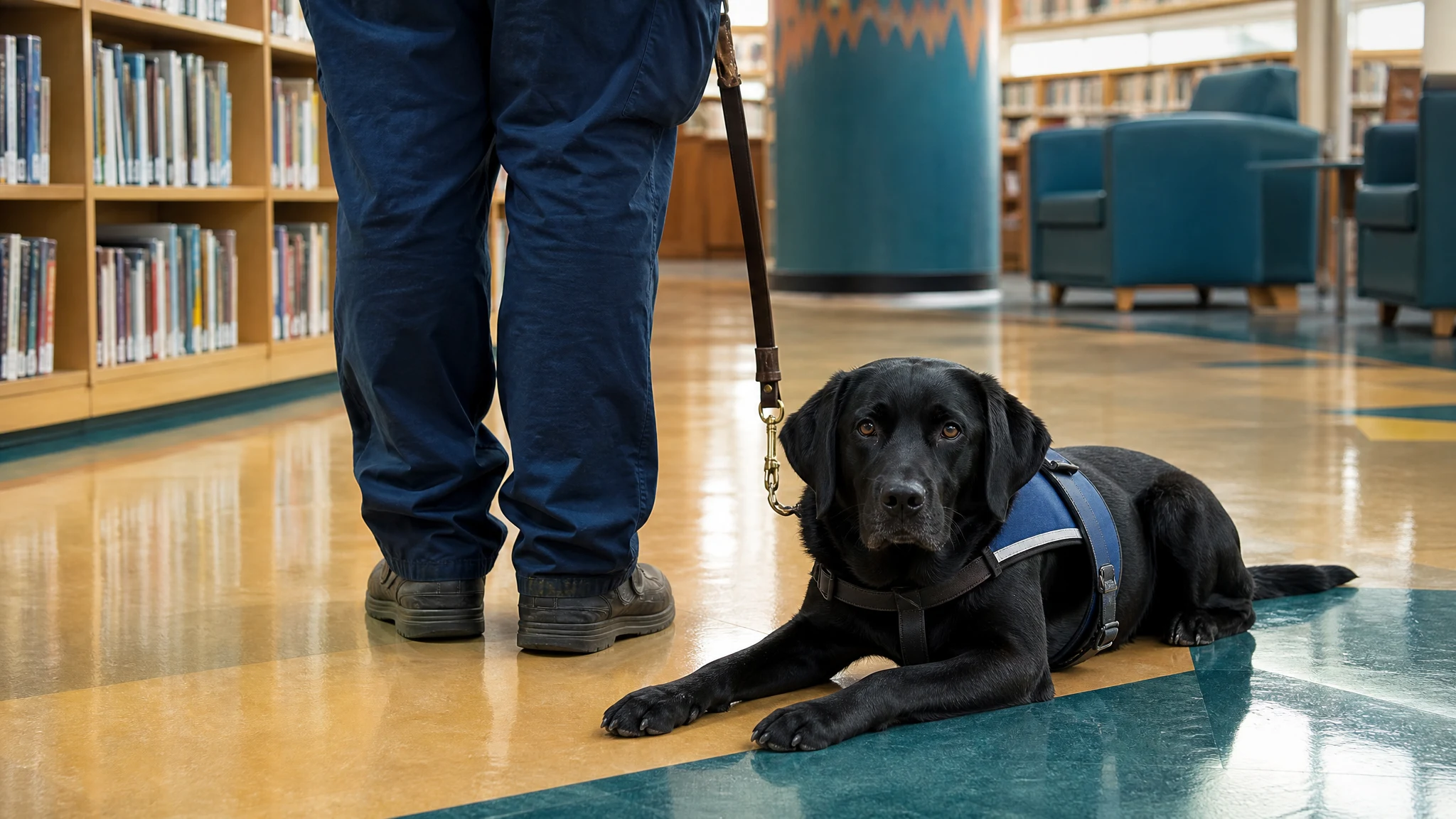
A service dog must be under control in public. New Mexico law ties access to the animal being under the control of an owner, trainer or handler, and allows access to be denied where the animal poses a direct threat of significant harm to the health or safety of others. In practice, that means practicing in gradually busier places, with distractions, and building the dog's confidence.
Keep sessions short and positive. Stop before the dog is tired or stressed. A dog that is anxious in a crowd should be given more time, not pushed harder.
Health, temperament and ongoing work
Regular veterinary care matters for a working dog's comfort and longevity. Your veterinarian can advise on health and fitness for the work. Training also does not end. Skills need regular practice, and a change in your health or routine may call for new tasks.
Working with a trainer
We do not recommend specific trainers, because no vetted list of New Mexico trainers is available to us. If you hire help, ask how they train, what methods they use and whether they will explain each step. Choose a trainer who uses reward-based methods and welcomes your questions.
Costs, Waitlists and What Is Not Published
Cost is one of the first questions people ask. The honest answer is that we cannot give you reliable New Mexico figures, and we will not guess.
- Assistance Dogs of the West (Santa Fe): The cost of receiving a dog is not published. For the Owner Self-Training program, it says additional costs may apply based on the number of training hours needed. Its waitlist is unknown.
- Service Dogs of New Mexico (Albuquerque): Cost is not stated on the pages we reviewed. The page says it is accepting 2026/2027 new client applications, but does not state a waitlist length.
- Paws and Stripes (Albuquerque): The organization publishes that its services are free to veterans, military service members and their families. Its waitlist is unknown.
Whichever route you choose, ask direct questions. What is the total cost? What does it include? What ongoing costs should I expect, such as food, veterinary care, equipment and refresher training? How long is the wait? What happens if the dog does not complete training?
Remember that under New Mexico's Service Animal Act, no additional charge may be imposed for a qualified service animal by a place of public accommodation. The handler may still be liable for damage the animal causes if a person without a disability would be liable for similar damage.
New Mexico Organizations and Veteran Programs
The organizations below are the ones we can point to. We have not tested or reviewed their services, and details may have changed. Contact each one for current information. We could not confirm a full accredited-member directory for New Mexico or a state VA service dog program, so check with the organizations and the VA directly.
Assistance Dogs of the West (Santa Fe)
Assistance Dogs of the West (ADW) in Santa Fe is listed as accredited by Assistance Dogs International. It serves people with mobility needs, seizure disorders, diabetic alert needs, psychiatric conditions, PTSD and developmental disabilities, and it places facility dogs. It also offers the Owner Self-Training program mentioned earlier. See adw505.org.
Service Dogs of New Mexico (Albuquerque)
Service Dogs of New Mexico is a nonprofit in Albuquerque. It says it specializes in assisting veterans, adults and children in New Mexico. Its page says it is accepting 2026/2027 new client applications. See servicedogsnm.org.
Paws and Stripes (Albuquerque)
Paws and Stripes is a nonprofit in Albuquerque serving veterans, including those dealing with PTSD and service-connected trauma. Its Veteran Service Dog Program is a 12-month program where veterans train with a dog from day one. The program is free, with a capacity of 20. Veterans must be 18 or older and bring photo ID. It serves Bernalillo, Sandoval, Santa Fe, Torrance and Valencia counties. The listed contact is (505) 999-1201. See the Veteran Service Dog Program page and pawsandstripes.org.
Warrior Canine Connection (Assistance Dogs of the West)
This program works differently. Veterans learn to train service dogs for other people, which is meant to ease trauma symptoms and isolation for the veterans doing the training. It meets weekly in Albuquerque, Santa Fe and Taos. It is free, open to ages 18 to 100, and its waiting list is listed as "Never." The listed phone is (505) 986-9748. See the program page.
Note that this program is about training dogs for others, so it is not a way to receive a dog for yourself. Ask the program how it fits your goals.
State resources
The New Mexico Governor's Commission on Disability publishes a Service Animals page and offers technical assistance. It is a good place to start with questions about state law. We found no state service dog ID program, so no state-issued card exists to apply for.
Where to Start: A Practical First-Steps List
- Clarify the need. Write down what daily tasks are hard and how a trained dog could help. This keeps you grounded in the ADA's work-or-tasks standard.
- Talk with your care team. Your doctor, therapist or other providers can discuss whether a service dog fits your health needs and may be asked to support a program application.
- Read the law. Review the ADA.gov Service Animals FAQ and the New Mexico Service Animal Act, Sections 28-11-1 to 28-11-6.
- Choose a route. Decide whether a program-trained or owner-trained dog suits your time, energy and circumstances.
- Contact organizations. Ask about eligibility, cost, timeline, training methods and what happens if a placement does not work out. If you are a veteran, ask about the veteran-focused programs above.
- Insist on humane methods. Any trainer or program should use reward-based training consistent with AVSAB guidance.
- Skip registries. No official registry or required certification exists under the ADA. Sellers of registrations, IDs and certificates do not give you legal rights, and an online registration is not legal proof.
- Plan for public access. Learn the two questions staff may ask, and practice answering them calmly and briefly.
- Know where to turn. Save the contact details for the Governor's Commission on Disability and the ADA.gov resources in case you face a denial.
A note on honesty and respect
Service dogs work because the public trusts that a dog in a vest is trained and under control. Handlers keep that trust by training well and behaving responsibly. Businesses keep it by asking only the permitted questions and treating handlers with respect.
Frequently Asked Questions
Do I need to register my service dog in New Mexico?
No. The ADA has no registry or required certification, and we found no state ID program for service dogs in New Mexico.
Can I take a dog in training into public places?
The Service Animal Act's definition covers dogs that have been or are being trained, and the Governor's Commission on Disability says animals in training get the same access. Confirm current details with the Commission.
Is an emotional support dog a service dog?
Not under the ADA, and not under New Mexico's definition. Emotional support animals may have protection in housing under the federal Fair Housing Act, according to the Governor's Commission on Disability.
Can a business charge a pet fee for my service dog?
Under Section 28-11-3, no additional charge may be imposed for the animal. You may still be liable for damage the animal causes if a person without a disability would be liable for similar damage.
Can I be asked to prove my dog's training?
Staff may ask only the two ADA questions when the need is not obvious: whether the dog is required because of a disability, and what work or task it has been trained to perform.
Sources
- ADA.gov Service Animals FAQ
- New Mexico Governor's Commission on Disability, Service Animals
- New Mexico Statutes, Section 28-11-2 (definitions)
- New Mexico Statutes, Section 28-11-3 (admittance of qualified service animal)
- New Mexico Statutes, Section 28-11-6 (false presentation)
- New Mexico Statutes, Section 28-1-7 (Human Rights Act)
- Assistance Dogs of the West
- Service Dogs of New Mexico
- Paws and Stripes
- Paws and Stripes Veteran Service Dog Program
- Warrior Canine Connection (Assistance Dogs of the West)